
A top leader of fundamentalist Jamaat-e-Islami party and Bangladeshi media doyen Mir Quasem Ali was sentenced to death on Sunday by a special tribunal for war crimes he committed during the independence war against Pakistan in 1971, days after the party's chief was given capital punishment on identical charges.

Terrorism struck at the heart of London after a vehicle veered off the road and mowed down pedestrians on London Bridge and witnesses described men with large knives stabbing passersby at nearby Borough Market.

'If chutzpah nationalists brought the Babri Masjid down, chutzpah secularists did precious little to stop it from being torn down.' 'If chutzpah nationalists ensured carnage in Gujarat, chutzpah secularists allowed Muzaffarnagar to become their next hunting ground.' 'Chutzpah secularists readily banned SIMI, but dragged their feet when it came to banning the Bajrang Dal.'

'China might soon have to seriously consider whether it prefers an Indo-US hyphenation to a Sino-Indian one.'
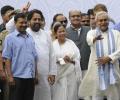
The elections in two eastern Indian states were keenly observed in Bangladesh for two major contentious issues, writes Prakash Bhandari from Dhaka.

'Nitish is now a helpless junior ally of Hindutva.' 'He just cannot think of reining in the hoodlums raging, marauding and killing in the mohallas,' argues Mohammad Sajjad.

'The year in pictures' treks across the globe, looking back on the moments that shaped 2016. From the United States presidential race, to demonetisation in India to the refugee crisis, the news has kept pouring in. Here are our top 50 moments from the world.

As the political battle for the future of Maharashtra's political quinquennial future nears its electoral conclusion, Shreekant Sambrani looks at the intertwining nature of national and regional interests and the place for and value of inclusiveness in electoral politics.

'China's growing nexus with Pakistan and the two countries' unresolved territorial disputes with India continue to pose a formidable national security threat to India,' says Brigadier Gurmeet Kanwal (retd).

Bearing in mind how full India's pitcher is with ethnic and communal complexities, only the greatest circumspection can hold this country together in a willing union.

'Mulk gets a lot of things right, including its vision of the country as a place where underneath the punctilious, forced-secular surface there are volatilities waiting to go off,' says Sreehari Nair.

With its refusal to accept the modern social values, the Indian Muslim community is going down the slope of progress, says Najid Hussain.

Mohammad Sajjad profiles Professor Riazur Rahman Sherwani, 94, versatile mind, intrepid intellectual.

'So a number of people are drawn in along with members of their friends' circle or their relatives.' 'A number of individuals find that they have more in common with the 'imagined community' that they discover online as opposed to their own physical community and indeed, even the majority Muslim community elsewhere.'
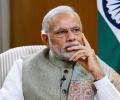
Like Nehru, Modi is loathe to touch the public sector. His policy towards Israel leans towards 'non-alignment'. You can find other similarities: frequent public speeches, personalised leadership, total control over foreign and strategic policies, even stylised dressing, says Shekhar Gupta.

Protectionism and a rollback of regulation. Defusion of tensions with Russia and a lowering of geo-political risks. Looser fiscal policy and tighter monetary policy. At least Donald Trump can't be faulted for not trying something different where existing policies have disappointed, says T T Ram Mohan.

The start of Indian lobbying in the US can be traced back to Pakistan's anti-India lobbying. Policy wonk Ashok Sharma documents this journey and its catalytic role in transforming the US-India relationship.

'They must take the bull of conservatism within their own ranks by its horns as much as they need to speak out against the fallacies of the non-Hindutva (or 'Muslim-friendly') political forces as well,' argues Mohammad Sajjad.

'It is exceptionally important for Hindus to once again get in touch with the foundation of Hinduism.' 'Aggressive evangelists are reducing Hinduism to its lowest common denominator.'

The White House said it has 'a large body' of evidence indicating that the Assad regime was responsible for the April 7 chemical attack in Duma.

'The court came to a conclusion using one person's case... Based on that one case, the term "rampant misuse" was used as if it is a generalisation.' 'If one in 10 cases turns out to be false, is it possible to call the Act a charter for blackmail or charter for personal vengeance?' 'Is there any Act either in India or anywhere in the world where there are no false cases?'
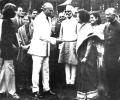
'Indira Gandhi, it appears, did not to consult her Cabinet colleagues, or diplomats, or civil servants when she decided to sign the agreement in Shimla.' 'We ruefully recall Bhutto's perfidy and the Indian prime minister's gullibility,' says Lieutenant General Ashok Joshi (retd).

Civil rights activist Lakshmi Sridaran argues why South Asians must stand on the right side of history and resist the Trump administration's "systematic attack on the entire spectrum of the US immigration system."

The escalating situation in the Kashmir valley is the vanguard actions of global jihad, says Brigadier S K Chatterji (retd). And in this battle, he believes, perception management operations will be just important as operations to neutralise the terrorists.
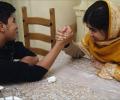
'She is a genuine, real, person who wants to be with girls who are suffering the way she suffered.'

The implications of the interim deal between Iran and the world's big powers go far beyond the nuclear programme, says Nitin Pai

PM Modi seems to be gradually ending India's strategic ambiguity

In the pitch dark of the African night, a herd of cape buffaloes gather at the watering hole for a drink, taking care to stay by the edge to avoid the crocodiles lurking in the depths. In Gangiova, a village in Romania, a doctor places her stethoscope to the chest of a newborn baby, listening intently for the beating of his tiny heart. These are just some of the moments that have been picked by the judges for the Sony World Photography Awards. For the 2017 competition, photographers entered 227,596 images across the awards' Professional, Open and Youth categories. The Open competition winner will receive $5,000 (Rs 3.3 lakh), Sony digital imaging equipment and flights and accommodation to the awards ceremony at Somerset House in London. Sony World Photography Awards has been kind enough to share some of their shortlisted pieces with us.

Hemal Trivedi, a Hindu filmmaker originally from India, and Mohammed Ali Naqvi, a Muslim from Pakistan have made one of this year's most talked about films.

'Manto is the only writer to grasp what the project of Pakistan would eventually mean,' says Aakar Patel, who has translated a collection of Saadat Hasan Manto's essays in a just-released book Why I Write.

'India was in no position to wage another war in 1965, having suffered a morale-shattering defeat in 1962. The three services were in the middle of a modernisation and expansion phase and therefore not fully trained or battle-ready.'

Trupti Desai's fight earned women the right to enter the inner sanctums of the Shani Shingnapur Temple, the Trimbakeshwar Shiva Temple and the Haji Ali Dargah. Her next target is Sabarimala in Kerala. Aditi Phadnis reports.

'We must begin dialogue with openness and goodwill, but we will not proceed very far without trust and good faith. The alternative is the violence of 'might is right,' which settles very little and destroys so much of real value,' says Dr Rudolf C Heredia, author of Religious Disarmament -- Rethinking Conversion in India.

More than 60 years ago, a bicycle thief in Louisville, Kentucky, unknowingly set in motion one of the most amazing sports careers in history.

'For its part, Pakistan often gives safe haven to agents of chaos, violence, and terror.'

'There are major implications for India. Though there was a transparently thin attempt to project the troop reduction as intended to promote peace, the downsizing is actually part of plans to streamline and strengthen the PLA, capable of defending China's national interests at home and abroad,' says Jayadev Ranade.

The ordinary life lived in Pakistan is rarely a part of Indian imagination. This is this gap that Pakistani television serials have succeeded in bridging, says Mohammad Asim Siddiqui.

The world is still figuring out the man as he continues his enigmatic journey towards the first 100 days of his presidency.

Countries in the region like Afghanistan, Pakistan and Maldives face serious existential threats from a mix of terrorist groups active in the region and elsewhere

'General Bajwa is believed to consider the internal threats to Pakistan's security as far more serious than the bogey of the Indian threat.' 'This doesn't mean that he is soft on India, only that he is more rational and sensible than his predecessor who had a bit of a chip on his shoulder about India,' points out Pakistan expert Sushant Sareen.
 © 2026 Rediff.com - Advertise with us - Disclaimer - Privacy Policy - Sitemap - Feedback - About us - Terms of use - Grievances